 By
By The way I can tell that a piece of media really stuck with me is that upon finishing it I will have a nonstop internal narration of all my thoughts and analysis on it, causing me to desperately scrawl out some kind of disorganized semblance of a book/TV show/movie review before the temporary loquaciousness evaporates my brain. This gets 1 million times stronger when I’m supposed to be doing something else, like right now (I have a philosophy final tomorrow)
(No I don’t, this post was started like nine months ago, and now, when I’m actually publishing it, I have graduated)
Why True Detective Season One Works
There’s a debate that’s sometimes floated when discussing fiction: which is more important, character or plot?
But that’s a nonsensical question. In reality, good characters beget good plots beget good writing; these elements of fiction, be it book or movie or TV show, rely on and develop each other in tandem.
True Detective works because it successfully incorporates developed characters, an intriguing plot, and skilled writing.
True Detective: Characters
It’s a common fan refrain that Season 1 is the only season of True Detective worth watching because it’s the only one that contains Rust Cohle. I can’t help but agree. The dynamic between Rust and Marty is the driving force of the season.

Rust Cohle’s Philosophy and Character Arc
It’s not an unpopular opinion to believe that Matthew McConaughey absolutely carried this season with his portrayal of Rust Cohle, an enigmatic and intense detective with an “unorthodox” way of viewing the world.

“I think human consciousness is a tragic misstep in human evolution. We became too self aware; nature created an aspect of nature separate from itself. We are creatures that should not exist by natural law. We are things that labor under the illusion of having a self, a secretion of sensory experience and feeling, programmed with total assurance that we are each somebody, when in fact everybody’s nobody. I think the honorable thing for our species to do is deny our programming, stop reproducing, walk hand in hand into extinction, one last midnight, brothers and sisters opting out of a raw deal.”
Yeah, it’s very teenager-who-just-discovered-Schopenhauer-and-Cioran but I think there’s always going to be that reaction to anything Pessimism or Antinatalism-related. People find it unpleasant and don’t want to take it seriously.
And frankly, Rust would not be Rust without it.
The “human consciousness” monologue is honestly what got me to watch True Detective in the first place. I find Pessimism to be a really compelling idea to explore both as a philosophical view and as a theme in my own sorry attempts at fiction.
In fact, I had read Thomas Ligotti’s The Conspiracy Against the Human Race over a year before I watched True Detective, and that book is cited as a direct inspiration for the show— something I didn’t even know until after watching it.
I definitely have a more generally positive view on life than Rust, but I would absolutely be a full fledged doomer too if my job involved looking at crime scenes every day.
(My own IRL outlook on life is analogous to harm reduction. Harm reduction in drug policy seeks to decrease the negative outcomes for drug users without trying to eradicate drug use– if it’s going to happen anyway, might as well make it safer. Similarly, I think though we cannot eliminate the harms of life, we should do our best to reduce those harms.)
The question for me, however, is how much of Rust’s outlook is a defense mechanism. He’s kind of a shoo-in “literally me” character but throughout the season and as his character arc progresses, we see how this is on some level to promote his tough exterior. He is running from a lot: his violent history on the job, the death of his daughter and dissolution of his marriage. At moments like when he says: “Think of the hubris it must take to yank a soul out of nonexistence into this… meat, to force a life into this… thresher. That’s… so my daughter, she spared me the sin of being a father” it’s clear that on some level, his outlook is shaped by his negative past.
In this respect, Rust’s final-episode concession that “If you ask me, the light’s winning” isn’t totally unbelievable, even if I wouldn’t have written his character arc that way. How much of his worldview was posturing and/or the manifestation of personal pain, rather than a deeply held opinion of the truth?
Marty As A Foil to Rust
Marty serves as a perfect foil to Rust, with a more conventional worldview and a role as the buddy-cop willing to call Rust out on his arrogance, like when he mocks the people at the religious service.
His character is compelling in other ways, too, being a garden-variety cop drunk on machismo and incompetence, caught in self-destructive habits that ruin his relationships and yet unable to change or even admit fault. While he can call out Rust, he can never call out himself.
The Plot: An Intriguing Subversion of the Classic Detective Story
I love a good detective story… and so do plenty of other people. From Agatha Christie to Law and Order to Knives Out, it’s a popular genre for a reason, even if the common tropes lend the genre to copaganda and cliche endings where everyone gathers in a room as the main good guy lays out his genius deductions.
And at the outset, True Detective seems like it’s going to be your normal kind of detective story. A dead woman, a likely serial killer, and two smart cops on the case. But as the season continues, it begins to subvert the genre.
In a classic detective story, it’s the good guys against the bad guys, the law against the criminals, and everything wraps up neatly in the end. In True Detective, however, nothing is that cut-and-dried.
Our two protagonists, Rust and Marty, are hardly upstanding cops. Rust is arrogant, nihilistic and a loose cannon; Marty is misogynistic, impulsive and abuses his position of authority. Both of them do a ton of police brutality and other questionable behavior.
And in the end, they don’t even end up solving the case with the legitimacy of the police department. Hell, they don’t even catch the entire satanic pedophile cabal at the end–only one guy, even though the conspiracy was much bigger and involved people in high places from local churches to the state government. Evil wins, in a way, but, as Rust says in his closing line, staring at the stars: “Once, there was only dark. If you ask me, the light’s winning.”
I’ll discuss this more in my section about the writing and atmosphere of the show, but True Detective is heavily inspired by the cosmic horror genre as well— also called eldritch horror or Lovecraftian horror. This subgenre of Horror often centers around the universe’s incomprehensibility and indifference to humans and derives its scares from entities whose natures and motivations are often inherently unknowable.
Despite its deviation from the standard detective story formula, though, the season keeps all of the intrigue of the mystery genre. From the first episode, I was hooked and eager to get to the bottom of the sinister disappearances. (In fact, I was a bit annoyed at all the sexcapades HBO just had to add in in the meantime)
The Writing: Building an Atmosphere
At the end of the day, like I discussed earlier, a the quality of a work depends on multiple different aspects. If True Detective had not been written so well, its characters and plot would not have saved it.
The dialogue between Marty and Rust illustrates their dynamic beautifully, and even Rust’s edgiest lines contribute to the show’s overall atmosphere.
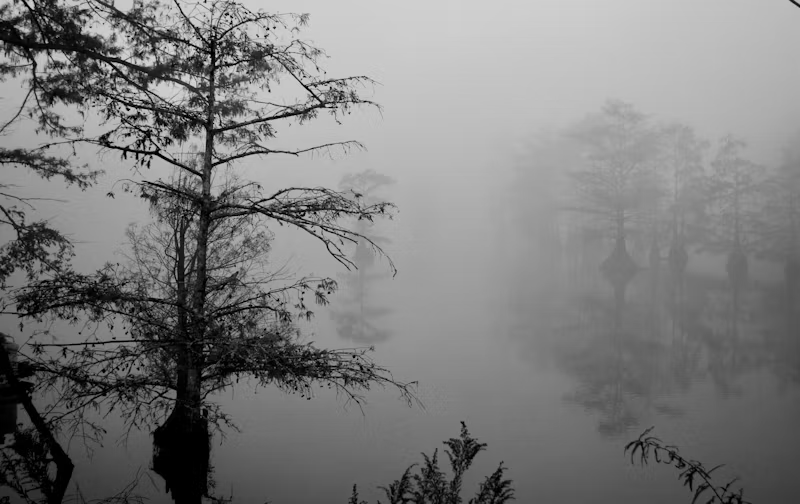
Set in coastal Louisiana, Season 1 adopts a Southern Gothic aesthetic. The cinematography is beautiful and the theme song…. let’s just say, it isn’t a famous intro sequence for no reason.

The Southern Gothic aesthetic synthesizes with the show’s incorporation of cosmic horror and existential dread, forming an extremely compelling atmosphere. “Vibe”, if you will.
Cosmic horror is a subgenre of horror most associated with H.P. Lovecraft (of racist cat name infamy).
It’s hard to pin down a strict definition or list of criteria for what makes a piece of media cosmic horror or Lovecraftian horror or what have you, but a general commonality seems to be the theme of humanity’s inability to comprehend existence. Whether it’s Lovecraft’s Cthulu entity or a faceless, entangled conspiracy of pedophilic cultists, characters grapple with forces beyond their control or even comprehension.

In fact, True Detective makes explicit homages to previous works of cosmic horror, most notably Robert W. Chambers’s 1895 The King in Yellow. (The Yellow King and Carcosa lore has been built up by multiple different authors over the years, and I’m going to write an explainer post on that and the other references in True Detective, like Nietzche’s Eternal Recurrence and M-Brane theory, one of these days!)
This thematic material of course goes perfectly with Rust’s philosophical outlook. The synthesis of Horror fiction and philosophy is not new– Nic Pizzolatto, the creator of True Detective, has even been accused of plagiarizing Thomas Ligotti’s book The Conspiracy Against the Human Race with some of Rust’s uncannily similar lines.
The Conspiracy Against the Human Race is an explicit synthesis of philosophy and horror. Ligotti, most known for his horror short stories, uses his venture into nonfiction to make his audience “grapple with the brutal reality that they are living a meaningless nightmare, and anyone who feels otherwise is simply acting out an optimistic fallacy.”
See also: Eugene Thacker’s Horror of Philosophy series.
Maybe I’m weird, but art that faces the bleak head-on is strangely comforting to me, and beyond True Detective, only the album Deathconsciousness by Have A Nice Life creates a similar vibe for me.