 By
By Which is creepier: Pennywise, or the way Stephen King wrote the main female child character of this book?
About the Book
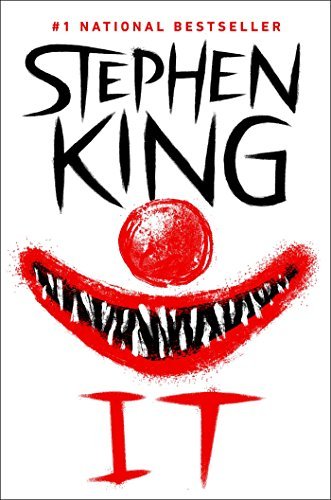
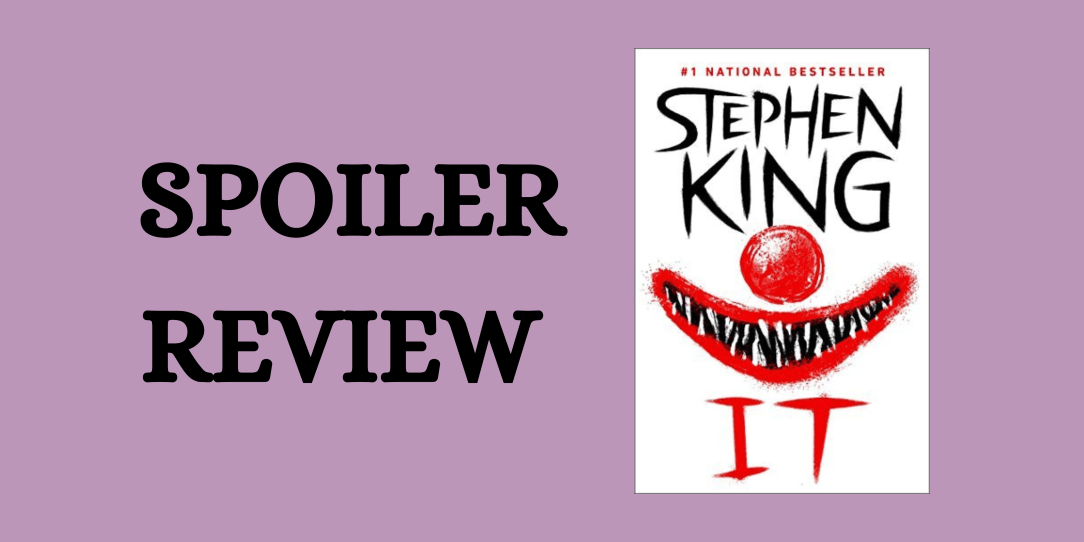
Title: It
Author: Stephen King
Published: 1986
Genre: fiction, horror, fantasy
The Premise
Synopsis (from Goodreads):
“Welcome to Derry, Maine. It’s a small city, a place as hauntingly familiar as your own hometown. Only in Derry the haunting is real.
They were seven teenagers when they first stumbled upon the horror. Now they are grown-up men and women who have gone out into the big world to gain success and happiness. But the promise they made twenty-eight years ago calls them reunite in the same place where, as teenagers, they battled an evil creature that preyed on the city’s children. Now, children are being murdered again and their repressed memories of that terrifying summer return as they prepare to once again battle the monster lurking in Derry’s sewers.”
SPOILER WARNING
This review contains spoilers and is mostly just a rant review about what I disliked about Stephen King’s It. If you intend to read the book yourself and don’t want to see spoilers, please close this tab and come back later! (I won’t be offended)
This is your one and only spoiler warning.
Resuming…
My Thoughts
I think that by now I’ve read enough King to articulate what frustrates me about his writing.
Beyond the weird, gross writing of female characters, including minors, many of his books are based on a comforting lie: that is, the battle between good and evil. Such a thing never exists in the real world.
If I have such a problem with King’s stories, why do I keep picking up his books, you may wonder? Well, honestly, I think he’s a good writer. His writing style is almost uniquely absorbing, and I have quite liked some of his work, namely Pet Sematary.
In It, the simplistic good vs. evil struggle was quite obvious, however, and it didn’t quite ring true for me.
The Simplistic Good vs. Evil Narrative
Sure, It, the titular entity, makes sense as being categorically evil.
But It is not the only villain of the novel. Central to the story is the ways in which the entity of It mirrors the non-paranormal perils of the children’s lives in Derry. The flesh-and-blood villains: Henry Bowers, Henry Bowers’s dad, Beverly’s dad, etc. are for the most part, comically evil. I mean, for god’s sake, Henry is also a child.
I was kind of thrown off by how violent all the children in this book are, because they’re supposed to be like 10-11 years old (which makes the synopsis calling them “teenagers” a bit bizarre as well) I know that some amount of their behavior was aggravated by It’s influence, but still… dang.
Beverly Marsh: A Creepily Botched Female Character
Stephen King is a permanent fixture of the r/MenWritingWomen subreddit, and for good reason; just about every one of his books (that I’ve read, at least) manages to shoehorn in at least one bizarrely horny sentence or predatory description of women. It might be the worst example I’ve seen.
Beverly — talk about mishandling a character. She could have been a great female character, but such a thing is too much to ask for in the hands of Stephen King.
Well, let me back up a second. Honestly, Beverly WAS a good character. She was badass, she had personality, she was my favorite one of the main characters, the Loser’s Club, to read about. However, the successful development of Beverly’s character was irrevocably marred by King’s WEIRD writing about women and girls.
As the only girl in the Losers Club, Beverly is constantly running into male chauvinism and spends much of the novel attempting to assert herself as an equal to the boys. This could’ve been a decent exploration of gender roles and how they are socially enforced and reinforced by children, but it is overshadowed by the fact that the rest of Beverly’s story is entirely male-centric. Whether she is being abused and lusted after by her father and by the bullies in childhood or by her husband in adulthood, most of her scenes center around violation of women. And this violation is not limited to the fictional characters. King himself feels the need to constantly describe eleven-year-old Beverly’s breasts and how her shorts are too short and her panties were showing. Jesus Christ, man.
Even among the Loser’s Club, Beverly is constantly described as the object of desire by all of the boys. Could this be realistic? I mean, sure — for the most part, their crushes on her were on the wholesome side.
Of course, until the infamous scene at the end. I think just about everyone knows what “THAT scene” refers to in It— I had heard rumblings about it long before I actually read the book. I knew that there was a sexual scene involving the main characters as children and that defenders of the book claim it was not eroticized and was important to the characters’ development. But… yeah, it wasn’t. It was genuinely worse than I thought.
I truly do not know what Stephen King was thinking putting that in there. Not only was it uncomfortable for obvious reasons, but it was completely bizarre in the context of the story too. It was a major non-sequitur in the narrative and further massacred Beverly’s character.
It solidified to me that in King’s mind, she was more of a sex object than a fully realized character.
Racism
I understand this book was written 40 years ago and a significant portion of the story is set in the 1950s, but Stephen, did you really need to put the n-word into this book so many times?
He does this in other books too, and it’s just as uncomfortable. Between him and Tarantino, I don’t know who wins the contest of which white guy can put more instances of the n-word in their writing for the sake of artistic expression, or whatever.
(While a lot of the book does have an anti-racist message, unfortunately, the racism in the book was not actually limited to the villains. Richie’s annoying character would not stop doing racial caricature voices throughout the novel!)
It Is Too Long
The real elephant in the room here is that this book is very overlong. 1184 pages, 444,414 words… let’s just say the revelation that he was deep into a cocaine addiction at the time of writing does not come as a huge surprise.
It’s certainly impressive to write a book so long, but in this case, the length was completely unjustified. The story is bloated with clear nostalgiabait for boomers and endless rehashing of the same stuff.
Where was his editor? I wondered the same thing reading The Stand.
While defenders of the length will say that the 1000+ page length facilitated the development of a realistic story with deeply fleshed out characters, characters whose lives we see from childhood to adulthood and whose formative experiences we learn about from multiple angles, I think that the length did more harm to the story than good.
While, sure, we got to know the seven main characters super well, King also began to lose me as a reader.
In the first few chapters of the book, I was absorbed. I wanted to know what this sinister entity lurking in Derry was, and how it could be stopped. I found Stan’s suicide scene particularly chilling. However, after the beginning, the book slowed down to a crawl pace. Reading the minute details of all of these characters lives for hundreds of pages, I began wondering why I picked up this book in the first place. Every encounter with It is described in such a way that it became repetitive; by middle of the book, the entity was no longer scary or even really creepy, and I just began rolling my eyes whenever there was a new encounter because I knew it would be more of the same. The children would come into contact with It, who assumed the form of a creepy monster, the children would escape (mostly) unscathed, and redouble their resolve to kill It.
Eventually I was counting down the pages until finally, I would reach the confrontation in which It would be vanquished— and I knew, of course, that in said final confrontation, good would prevail over evil, because this is a Stephen King book with simplistic morality.
Pennywise Didn’t Scare Me
Another thing about this book that made it lackluster for me is that for the most part, I wasn’t scared of Pennywise.
There were some sections in this book that were scary, to be sure— but overall, I’m not scared of clowns, and I’m not scared of mysterious paranormal entities, for the most part, since I don’t believe in them.
Well, duh, you might be thinking, it’s a fantasy book, it’s not real— why is this even worth commenting on?
The thing is though, I have been seriously disturbed by horror novels before, including some of Stephen King’s — because they dealt with themes that I am scared of in real life, too. Specifically, I’d count Pet Sematary and the opening chapters of The Stand among some of the most disturbing media I’ve ever consumed (though maybe nothing will top Black Mirror’s “White Christmas” episode).
Of course, this is a personal preference, and Pennywise has certainly made a mark on the popular horror imagination. However, I had far more anxiety reading the scenes with the bullies than I did reading the scenes with Pennywise.
Though, maybe that was King’s intention, as a significant part of this novel’s concept is the ways in which the children overcoming It parallels them overcoming the real-life monsters in their lives, like bullies, abusers, and self-doubt
Anyway, I would definitely not consider It among my favorite Stephen King books. Please feel free to leave a comment if you agree (or disagree!) with any of my takes, or if you have other books to recommend!
If you liked this post, consider subscribing to Frappes & Fiction. I post about the books I read (even if they’re not fiction), the books I think YOU should read, and anything else on my mind.

 Frappes and Fiction