
 By
By This book really messed with my head.
About the Book
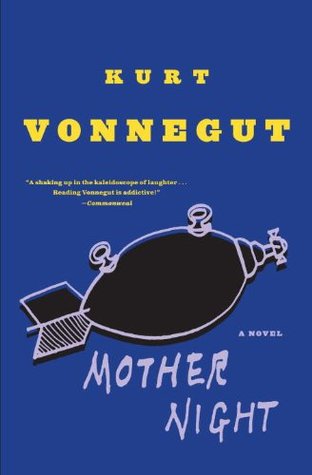
Title: Mother Night
Series: (standalone)
Author: Kurt Vonnegut
Published: 1961
Genre: classics, historical fiction
My Rating: 5/5 stars
The Premise
Synopsis (from Goodreads):
“Mother Night is a daring challenge to our moral sense. American Howard W. Campbell, Jr., a spy during World War II, is now on trial in Israel as a Nazi war criminal. But is he really guilty? In this brilliant book rife with true gallows humor, Vonnegut turns black and white into a chilling shade of gray with a verdict that will haunt us all.“
(Not sure why classic books by famous authors always have these kinds of blurbs)
My Thoughts
Much like Slaughterhouse-Five, when I finished this book I was left with a heavy, inescapable feeling of… depression and emptiness. I felt like I had to take a few days just to wallow in how screwed up this world is.
I liked Slaughterhouse-Five, but Mother Night was even better and comparatively very underrated. (In the time since I read this, I’ve also read Cat’s Cradle and guess who my new favorite author is now?)
Mother Night follows a man named Howard W. Campbell, Jr. while he awaits his trial for Nazi war crimes. He had been a radio propagandist for the Nazis during WW2– while at the same time working undercover for the U.S. and transmitting secret messages to the Allies in his broadcasts.
“I would fool everyone with my brilliant interpretation of a Nazi, inside and out. And I did fool everybody. I began to strut like Hitler’s right-hand man, and nobody saw the honest me I hid so deep inside. Can I prove I was an American spy? My unbroken, lily-white neck is Exhibit A, and it’s the only exhibit I have.”
In the aftermath of the war, he goes into hiding to avoid prosecution. Eventually he is captured and sent to Israel to stand trial. Only a few people know that he was actually a spy; the rest of the world believes he truly was a Nazi, and the American government won’t do anything for him.
But, as the book examines… does it even matter that he was secretly a spy, when he played his undercover role so well?
Is he really any less guilty than his counterparts? Did the good he did by transmitting small messages to the Allies outweigh his pervasive contribution to the Nazi propaganda machine? What is the cost of complicity? And, in pretending to be a Nazi, had he become the moral equivalent?
“Three people in all the world knew me for what I was—” I said. “And all the rest—” I shrugged.
“They knew you for what you were, too,” he said abruptly.
“That wasn’t me,” I said, startled by his sharpness.
“Whoever it was—” said Wirtanen, “he was one of the most vicious sons of b*tches who ever lived.”
Mother Night’s Examination of Morality and “We are what we pretend to be”
The overall main message of the book– and I know it’s the overall main message of the book because it’s explicitly stated by Vonnegut at the beginning– is, “we are what we pretend to be, so we must be careful about what we pretend to be.”
This wasn’t a new concept to me (it’s kind of the message of Mean Girls too if you think about it) but the way this book conveyed that concept was incredible.
As the story unfolds, so does this message about morality and complicity. You come to the same realizations as Campbell does as the plot progresses, and the effect is palpable.
The one scene in this book that really blew my mind was when Campbell is talking to his father-in-law in Germany, who confesses the impact Campbell’s propaganda show had on him and says that he wouldn’t even care if Campbell had been a spy the whole time:
“You could tell me now that you were a spy, and we would go on talking calmly, just as we’re talking now. I would let you wander off to wherever spies go when a war is over. You know why?” he said.
“No,” I said.
“Because you could never have served [the Allies] as well as you served us,” he said. “I realized that almost all the ideas that I hold now, that make me unashamed of anything I may have felt or done as a Nazi, came not from Hitler, not from Goebbels, not from Himmler—but from you.” He took my hand. “You alone kept me from concluding that Germany had gone insane.”
After I read this passage my stomach dropped and it was like… a new window opened in my brain. Throughout the whole experience of reading this book, it feels like you are Campbell– and so it felt like it was me having this horrifying moment of realization. The implications of the situation didn’t really hit me until that moment.
I think the reason why I found this book so disturbing was because it’s all about how you could do something horrible even with the best of intentions, and not even realize the impact of your actions until it’s too late.
Campbell gives up his apolitical life as a playwright in Germany and agrees to become a spy because he believes it’s the right thing to do. He plays his role as a Nazi as well as possible, blending in for the purpose of conveying the secret messages to the Allies. He acts just like the Nazis, but it’s not him, right? It’s just an act. He sacrifices his reputation and conscience for this cause, and it’s just a small self-sacrificial price to pay for the greater good. He knows he’s innocent, and all he needs if for the rest of the world to realize it too. But then he starts to find out that actually, maybe this was all wrong…
“If there is another life after this one, I would like very much, in the next one, to be the sort of person of whom it could truly be said, “Forgive him—he knows not what he does.” This cannot be said of me now. The only advantage to me of knowing the difference between right and wrong, as nearly as I can tell, is that I can sometimes laugh when the Eichmanns can see nothing funny.”
Propaganda and Responsibility
Is Campbell responsible for the Holocaust because of his role in spreading Nazi propaganda?
“I had hoped, as a broadcaster, to be merely ludicrous, but this is a hard world to be ludicrous in, with so many human beings so reluctant to laugh, so incapable of thought, so eager to believe and snarl and hate. So many people wanted to believe me! Say what you will about the sweet miracle of unquestioning faith, I consider a capacity for it terrifying and absolutely vile.”
So, are you responsible for people believing your lies? Does it make you morally complicit? What is the power of propaganda?
There’s also this really really amazing passage about willful ignorance and the “totalitarian mind”, with an analogy about how people remove teeth from their “thought machines”– that is, ignore any inconvenient facts– in order to justify the unjustifiable, and it is just very good. I can’t paste the entire quote here, as it’s basically an entire chapter, but here’s my favorite part:
“Since there is no one else to praise me, I will praise myself — will say that I have never tampered with a single tooth in my thought machine, such as it is. There are teeth missing, God knows — some I was born without, teeth that will never grow. And other teeth have been stripped by the clutchless shifts of history — But never have I willfully destroyed a tooth on a gear of my thinking machine. Never have I said to myself, ‘This fact I can do without.”
The ending also gave me chills and made me just want to sit and stare at the wall for the foreseeable future. My Kindle notes are full of highlights. And I loved this book.
The Verdict
So, this book is really good and I would highly recommend it, especially if you like historical fiction or satire/dark comedy, and don’t mind being depressed for a couple of days.
As I said earlier in this review, I think I have a new author to add to my favorite authors list…
Have you read Mother Night? Any other books by Kurt Vonnegut? Let me know in the comments!
If you liked this post, consider subscribing to Frappes & Fiction. I post about the books I read, the books I think YOU should read, and anything else on my mind.
 Frappes and Fiction
I have not read this, but wow, it sounds so intense.
LikeLiked by 1 person
Loved reading your review. I had just read this book and was blown away by how bonkers it was (and also rather depressing in the end). I enjoyed it as a slight narrative sequel to Slaughterhouse-Five but it really feels much darker, although the sheer absurdity of all the twists and turns lightens things a lot.
Between the tragic elements and the constant spy/disguise/duplicity threads, it’s kind of Shakespearean. I will have to go back and check if Campbell ever says he took the spy position because he thought it was right, because I don’t remember that as a strong sentiment of his. Instead, his mode seemed to be “just following orders”, which, ironically, he uses as a zinger at the other Nazi. Campbell, in the end, seems to be one of the people he describes as always needing to be told what to do (and not just because he becomes catatonic for a time) — he played a role, and threw himself into it. I think that’s why his character was written as a playwright. “Bernard O’Hare”, the character Vonnegut gave the name of his old war buddy, says that he feels he was born to be Campbell’s enemy — you might say it’s the role he was born to play. I truly think the secret moral of the book is the old chestnut “All the world’s a stage, and all the men and women merely players.” But free will struck me as a much stronger theme here than even in Timequake. We are certainly free to choose the roles we play.
Great book!!
LikeLike
Loved reading your review. I had just read this book and was blown away by how bonkers it was (and also rather depressing in the end). I enjoyed it as a slight narrative sequel to Slaughterhouse-Five but it really feels much darker, although the sheer absurdity of all the twists and turns lightens things a lot.
Between the tragic elements and the constant spy/disguise/duplicity threads, it’s kind of Shakespearean. I will have to go back and check if Campbell ever says he took the spy position because he thought it was right, because I don’t remember that as a strong sentiment of his. Instead, his mode seemed to be “just following orders”, which, ironically, he uses as a zinger at the other Nazi. Campbell, in the end, seems to be one of the people he describes as always needing to be told what to do (and not just because he becomes catatonic for a time) — he played a role, and threw himself into it. I think that’s why his character was written as a playwright. “Bernard O’Hare”, the character Vonnegut gave the name of his old war buddy, says that he feels he was born to be Campbell’s enemy — you might say it’s the role he was born to play. I truly think the secret moral of the book is the old chestnut “All the world’s a stage, and all the men and women merely players.” But free will struck me as a much stronger theme here than even in Timequake. We are certainly free to choose the roles we play.
Great book!!
LikeLike
That’s an interesting read, you may be right. I’ll have to re-read it. I haven’t read Timequake yet but I have a copy! I’ll have to get on it soon
LikeLike
Thank you for this excellent review. I just finished reading Mother Night yesterday, and your thoughts helped me work through my own feelings about the book.
The story is not dated at all. When I look at many cable news hosts and politicians who support clearly outrageous ideas — and I just *know* they are smarter than what they present — you can clearly see Vonnegut’s frame of reference: You are what you pretend to be, so be careful what you pretend to be.
This novel was genuinely devastating.
LikeLiked by 1 person
Absolutely. Thanks so much for leaving a comment on my review!
LikeLike