
 By
By C.S. Lewis, in my experience, is the darling of those Christian missionaries who hand out religious books to random people on my college campus, and Mere Christianity is perhaps his most well-known and well-lauded book. Perhaps predictably, I am not a fan of it.
About the Book
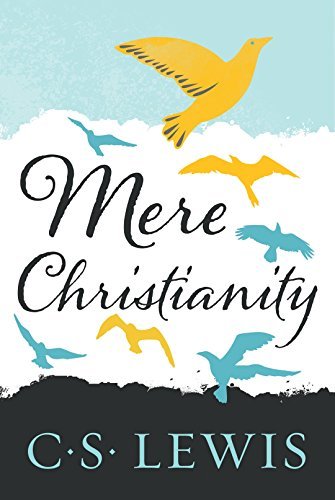
Title: Mere Christianity
Author: C.S. Lewis
Published: 1942
Genre: Christian, theology
My Rating: 1/5 stars
My Thoughts
Mere Christianity is C.S. Lewis’s general overview of Christianity– the “mere” modifier is there because it’s not supposed to be about any specific sect of Christianity, just the idea itself.
While I enjoyed the way the book was written in a clear explanatory format and Lewis’s voice is strong, I didn’t find his arguments for the veracity of Christianity to be all that convincing.
He starts the book with a discussion of why he believes the existence of objective morality points to Christianity. He argues that it seems that every person has some sense of objective morality in them. Everyone seems to innately know that rape and murder is wrong, for example. This is one of the things that makes me think maybe pure materialistic atheism isn’t right, or at least isn’t very sustainable. But, I would counter, do we actually know morality is objective? Because in a lot of cases it’s not, or at least, it doesn’t seem to be.
If God instilled this sense of objective morality in us, then why do people disagree so strongly on moral issues? The most controversial issues of today (abortion, euthanasia, animal rights, etc.) don’t seem to point to any sort of universal moral creed that we all share. Also, different societies have different morals, and a lot of our morals are based upon the society in which we live. How much of our morals is nature and how much is nurture?
I myself am not sure of the existence of objective morality, but then on the other hand, this is kind of a scary thought, because obviously there are things that are morally wrong. I’m someone who places great value on my morality and not having something concrete on which to base this morality troubles me a lot. It would be a lot simpler if I could say that my morals come from God. In any case, secular basis for morality could be something like utilitarianism or just simply “the golden rule.”
But there’s another problem I had with Lewis’s logic here. He jumps straight from “we all have a conscience that tells us when we have done something wrong” to “therefore the Christian God exists.” He acknowledges this leap somewhat, but doesn’t exactly explain it away well enough for my liking.
All this argument proves is that humans have some sort of morality driving us to think some things are right and others wrong. Where does this now point to a deity, let alone the very specific deity proposed by Christianity? Also, not everyone has a conscience.
Lewis also tries to justify Christianity by saying that it’s just too complicated to be made up by someone, or that it seems just counterintuitive enough to be real. This is honestly so illogical that I need not elaborate further for you to see how desperately Lewis is grasping at straws.
The quote that is often cited from this book is this one: “If I find in myself desires which nothing in this world can satisfy, the only logical explanation is that I was made for another world” which is used as evidence that we were actually created to live in heaven, not earth. But this quote makes zero sense to me. I can think of several other logical explanations for why you have a desire that nothing in this world can satisfy. Just because you want something to be true doesn’t mean it’s true. Maybe I find in myself desires for a chocolate cake– but that doesn’t mean I’m destined to get one.
The book also goes into a discussion of Christian morality, which is valuable to society… except for the homophobia and misogyny, of course. Oh, and the valorizing of blind faith, and the child sacrifice, and the genocide. And the gleeful delight in the idea of nonbelievers burning alive for eternity.
The last couple of chapters are a rather confusing discussion of Christian theology, mostly about the Holy Trinity and whatnot. I didn’t really realize this before, having grown up with the concept, but the Trinity is a very weird idea. I was talking to a Muslim friend the other day, who was saying that Christianity confuses her because of the “three gods but one god and one is the son of the other but they’re the same thing and there’s also another thing called the Holy Spirit” idea.
However, I thought the theory Lewis speculated about with the Trinity being possible because God exists in some higher dimension to be really interesting, though. I also thought that Lewis’s resolution of the omnipotent/free will paradox using the idea of time as a 4th dimension and a God who can see the whole timeline at once (think the Tramalfadorians from Slaughterhouse-Five) was clever and made a lot of sense, if you’re willing to substitute sense for mythology and elaborate speculation.
Overall, I did not find C.S. Lewis’s arguments in Mere Christianity to be particularly convincing. I read this book back when I was deconverting, and, if anything, it accelerated my total loss of faith in God. Honestly, I expected someone with such a hefty reputation in Christian apologetics to make a better case for the religion, but I’m not the target audience. The only people I can really see being convinced by this book are the ones who already believed to begin with, and would like some cleverly-worded reassurances that their God is the right one.
If you liked this post, consider subscribing to Frappes & Fiction. I post about the books I read (even if they’re not fiction), the books I think YOU should read, and anything else on my mind.

 Frappes and Fiction
I think you nailed the incoherence of Lewis’ morality argument. Claiming “objective” morality while living in a world that clearly exhibits a spectrum of moral codes is baffling. I agree that I find the lack of objective morality nerve racking (there are things that I would want everyone to agree are wrong), but I think it’s possible we can reason our way to morality. Although not “objective” we can ground morality in more concrete terms like “the well-being of sentient beings” (I think Sam Harris’ definition is close to that) or just minimizing harm. The irony of the “God as root of morality” argument is that God’s morals fluctuate throughout the Bible.
LikeLiked by 1 person
Yeah. Recently, I was having a conversation about veganism with a Christian and they said, “well, as an atheist, you can’t provide any basis for that morality.” I said, “what is your basis?” they said God, so I asked “are you okay with child genocide? that’s something God does in the Bible”
LikeLiked by 1 person
Exactly. And then you get the excuses of god’s ways being higher than ours and we just can’t understand his ways. 🙄
Also, apologies for the two comments. I didn’t realize the first one posted.
LikeLiked by 1 person
You hit the nail on the head concerning this issues with Lewis’ understanding of morality. I used to worry about moral relativism, but I think it’s what we are logically left with. Grounding morality in principles such as maximizing well-being (from Sam Harris) or protecting the rights and life of the individual (Michael Shermer) resonates more with me than the changing attitudes of a god, or to be more precise, the changing attitudes of what believers think their god is saying. Great piece!
LikeLiked by 1 person
The teachings within this religious text have the power to uplift and inspire hearts around the world.
LikeLike