
 By
By As an animal rights activist who is also a biology student, little has weighed on me more heavily in my day-to-day life than the ubiquity of biomedical animal testing.
About the Book
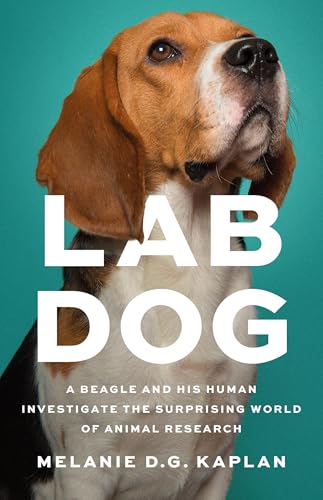
Title: Lab Dog: A Beagle and His Human Investigate the Surprising World of Animal Research
Author: Melanie D. G. Kaplan
Published: 2025
Genre: nonfiction, animal welfare, animal ethics, environmental, politics, memoir
My Rating: 5/5 stars
The Premise
Synopsis (from Goodreads):
“When journalist Melanie D.G. Kaplan adopted her beagle Hammy, all she knew was that he had spent nearly four years in a research lab. Curious to know more about this gentle creature’s past, as well as the broader world of animal research, Kaplan—with Hammy in tow—embarks on a quest for answers. How did Hammy end up in a research facility? Why are we still using millions of animals a year in experiments? What have we learned from them? Is there another way?
In Lab Dog, Kaplan investigates the breeding and use of beagles for biomedical research, drug and product testing, and education. She takes readers on a journey, peeking behind laboratory doors and visiting with researchers, activists, ethicists, veterinarians, lawmakers, and innovators. Along the way, she finds thoughtful and caring humans on all sides of the debate, explores promising developments in nonanimal testing, and discovers puzzle pieces from Hammy’s past. Equal parts journalism and love story, Lab Dog offers a nuanced view on our relationship with a species that we both love and exploit, and a reason to hope for a better future for all.”
My Thoughts
I’m about to start my last semester of my undergraduate Cell Biology degree, and every semester I have spent in my degree has put me further into disillusionment about the treatment of animals in research. It seems that every study mentioned in my classes and homework assignments involves animals in some way, and nearly every internship suggested to me on LinkedIn requires working with in vivo models. Every day on my way to class I pass doors with biohazard notices; the lab I interned in over the summer was computational, but each day I would see white-aproned people coming in and out of one of the animal labs down the hall.
There has been buzz around organoids and organ-on-a-chip technology, as well as in silico alternatives, but how close are we really to replacing animals in science? There are mixed opinions on the feasibility of eliminating animal research completely, as the practice as undoubtedly enabled massive breakthroughs in medicine and alternatives like organoids are not advanced enough to model full organisms yet.
I was and am extremely ethically troubled by the issue of animal testing, due to its conflict of personal values and continuous intrusion into my life. So when I found out that Melanie D.G. Kaplan was coming to speak to a vegan group in my city, I put the event on my calendar immediately.
At the talk, I bought a signed copy of Lab Dog and had a conversation with Kaplan about my situation as a biology student who is simultaneously an advocate of animal rights. After my schedule cleared up enough, I got to reading it.
Now enough about me. Let’s talk about the book itself.
Lab Dog begins by introducing the eponymous lab dog, Hammy, situating us in the scene of his 2013 adoption. Kaplan initially took him in as a foster dog from the Beagle Freedom Project, which rehomes former laboratory dogs. Eventually adopting Hammy formally, Kaplan became deeply interested in the system from which he had come, and set off on a years-long process of research to learn as much as possible about animal research in science. Why do we test on animals? What do we test on animals? How many animals, and what kinds of animals are used? Is there any other way?
Throughout the process, she was also searching for clues to Hammy’s origins: what institution had he been born into, and how had he ended up being rehomed? Had he been used for experiments?
The framing of the book around Hammy’s story and the quest to uncover his origins gave Lab Dog an engaging narrative hook to soften the often depressing and fact-heavy content of the work.
Kaplan truly did the work to explore every nook and cranny of this issue, from radical animal rights organizations to PIs and lab workers who defend their use of animals to advance science. She interviewed people from both sides of the issue and everywhere in-between. Although journalistic objectivity is fiction, I found the book did a really good job of giving its subject a fair hearing, and I learned quite a lot from it.
To be honest, I had not even known that dogs were still often used in experiments before I read this book. To many, it seems an outdated practice (due to society’s speciesist preference for dogs, I did not expect that they were still used in such a way.) I also hadn’t known the distinction between basic, translational, and clinical research, or the use of animal bodies for veterinary students to practice procedures.
Lab Dog is also very sweeping in its coverage. It includes sections on the history of biomedical research and the history of the antivivisection movement, interviews with scientists and ethicists, and even information about companies working in the area of alternative technologies.
I would recommend this to anyone, as I believe it is something that more people need to be educated on. I considered myself relatively well-versed on the subject, but I ended up learning quite a lot from the book. It would be an especially good read for animal rights activists and aspiring researchers as well.
If you liked this post, consider subscribing to Frappes & Fiction. I post about the books I read (even if they’re not fiction), the books I think YOU should read, and anything else on my mind.
 Frappes and Fiction