
 By
By What, are you seriously telling me we can’t trust corporations? No way.
About the Book
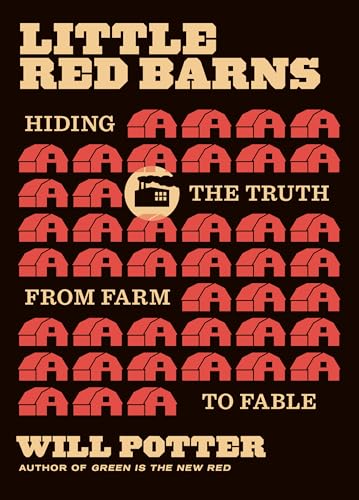
Title: Little Red Barns: Hiding the Truth from Farm to Fable
Author: Will Potter
Published: 2025
Genre: nonfiction, animal rights, environmental, politics, memoir
My Rating: 5/5 stars
The Premise
Synopsis (from Goodreads):
“Little Red Barns is a groundbreaking investigation of factory farms and the unprecedented measures being taken to hide their impact — on animals, public health, and the environment — from the public.
Will Potter had planned to write a book about a troubling form of censorship, namely, a host of new “ag-gag” laws that criminalize photographers and journalists as terrorists for their efforts to expose abuses on factory farms. But his work soon expanded into a much larger investigation of a nexus of political corruption and corporate power that works to silence protest and to obscure reality with propaganda. What emerges is a chilling account of the secret campaigns of weaponized storytelling being used to prevent us from seeing the ecological, public health, and authoritarian threats that these farms represent.“
My Thoughts
After reading Green Is the New Red: An Insider’s Account of a Social Movement Under Siege, I was excited when I found out Will Potter was releasing a new book this summer. I pre-ordered it from City Lights Books (which several months later I got to visit in person and loved).
Though I started reading the book as soon as my pre-order arrived, it took me quite a long time to get through. Not because the book isn’t well-written, but because, as an animal rights activist, I am in that funny space somewhere between desensitized and hyper-reactive to the horrors of how animals are treated in modern society. I’ve seen so many videos–so many of the same videos–heard so many of the same stomach-churning facts that I hardly bat an eye telling you that baby chicks are shredded alive in a gigantic grinder or that pigs can spend months unable to move more than a few feet and forget seeing the sun until they go to slaughter– but still I wasn’t sure I could stomach an entire book about factory farming. Despite how much I know, it still keeps me up at night.
“So our animals can’t turn around for the 2.5 years that they are in the stalls producing piglets. I don’t know who asked the sow if she wanted to turn around…. the only real measure of their well-being we have is the number of piglets per birth which is at an all-time high” -Dave Warner (National Pork Producers Council Director)
Fortunately, though Potter devotes an appropriate amount of page time to emphasizing exactly how horrendous the reality of animal treatment in the 21st century is, that wasn’t the full extent of this book. You can educate yourself much more viscerally by watching this and other undercover footage than by reading any screed, and I think Potter knows that too. Thus, the focus of Little Red Barns is more on exposing the propaganda mill of Big Ag.
“We all know what a farm looks like. It is full of happy cows, happy pigs, and happy chickens. Happy farmers work outside in overalls and wide-brim hats, and little red barns dot the countryside. We all know this, because it is a story we have been told our entire lives.”
When I first went vegan, three years ago now, I was shocked and angry about just how ill-informed I had been to the realities of factory farming. (This was back in the days when I believed in the ability of consumer choice to solve all ills, and that the government simply does not allow evil to exist. If things were really so bad, they would be illegal, certainly! How my illusions were shattered by adulthood)
But my ignorance wasn’t the exception. Massive corporations have made it their aim to hide the truth from consumers. That’s why products are decorated with idyllic farmyard illustrations, given names like “the Laughing Cow”, stamped as Organic and Certified Humane or RSPCA-Assured even when such distinctions are bullshit when it comes down to actual suffering animals. That’s how we get ag-gag laws–the criminalization, essentially, of citizen journalism. That’s why animal rights “terrorists”, who release animals, rescue them, or, God forbid, take a couple photos, are stamped as dangerous threats and subjected to federal surveillance even as fascists and white supremacists fall into the FBI’s blindspot, it seems.
If I could summarize Little Red Barns in a sentence, I would say it is about corruption. It is about how all this has emerged as the state of things. While Green is the New Red focused on the disproportionate targeting of animal rights and environmental activists by the federal government, Little Red Barns is about how industry can bribe and manipulate both public perception and legislation in their favor.
Little Red Barns also explores the rise of the far-right and how the aesthetics of fascism intertwine with those of the “little red barn”, harkening back to false nostalgia for a simpler time when we women drank raw milk and cooked our husbands dinner while zonked out on benzos. What seems a spurious connection at first–between meat-eating and fascism–becomes more and more clear when you think about how seemingly disparate social justice issues are connected by parallel mindsets and thought processes.
In that vein, I appreciated the discussion and theorizing about why animal rights and environmental activists are somewhat alienated from the rest of the left. Animal rights in particular is often scoffed at even by those whom you’d think expect to support a movement which defends the most downtrodden and overlooked in society: nonhuman animals. Why aren’t more leftists vegan? The reasons for this are complicated and informed by several factors, and I was glad to see the phenomenon discussed here, since I’ve long been troubled by it. Veganism is often (unfairly, in my opinion) seen as a frivolous, inaccessible movement primarily adopted by privileged white people. Why does this perception exist, when by all accounts, a philosophy against exploitation aligns perfectly with the principles that defenders of human rights also value?
Finally, Little Red Barns, despite its tour through fields of shit and factories of torture, fascist extremism, and alienation manages to end on a somewhat positive note. How can we maintain our mental health in the face of so much evil, Potter asks. The answer according to him is to bear witness and speak up about what we have seen, galvanizing grassroots support to use the best of humanity to fight the worst. I’m certainly in, are you?
If you liked this post, consider subscribing to Frappes & Fiction. I post about the books I read (even if they’re not fiction), the books I think YOU should read, and anything else on my mind.
 Frappes and Fiction