 By
By About the Book
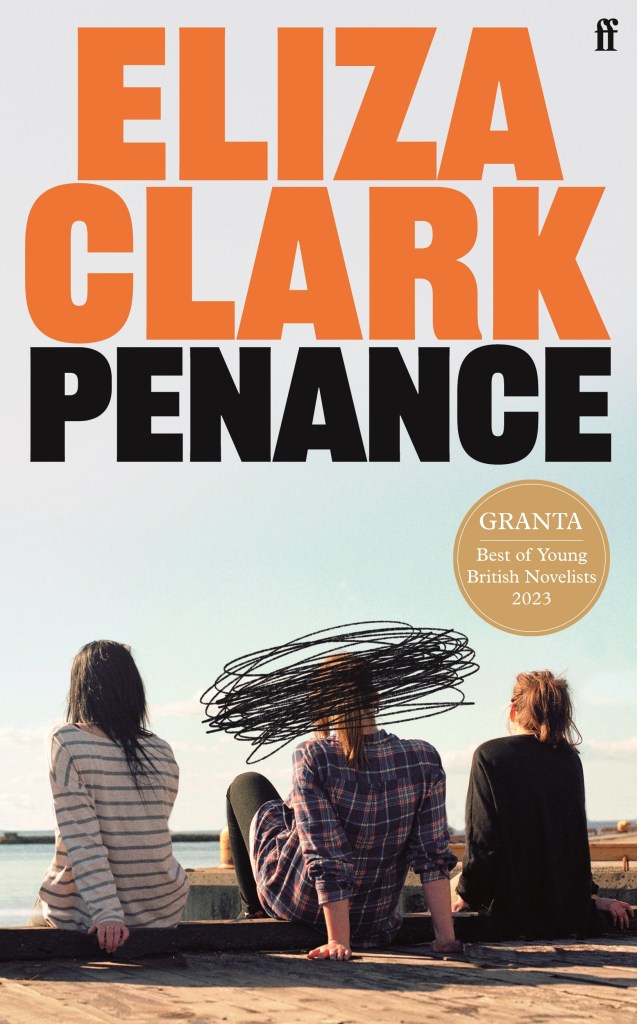
Title: Penance
Author: Eliza Clark
Published: 2023
Genre: literary fiction, mystery, thriller, crime
My Rating: 4/5 stars
The Premise
Synopsis (from Goodreads) (shortened):
It’s been nearly a decade since the horrifying murder of sixteen-year-old Joan Wilson rocked Crow-on-Sea, and the events of that terrible night are now being published for the first time.
The only question is: how much of it is true?
My Thoughts
Do you know what happened already?
Did you know her?
Did you see it on the internet?
Did you listen to a podcast?
Did the hosts make jokes?Did you see the pictures of the body?
Did you look for them?
Wow… that was a heavy read. I mean, of course it was– it’s not exactly like I thought a book with this synopsis would be some sort of beach read, but still, I was surprised by exactly how deeply unsettled I felt after reading it. I picked it up expecting something similar to Clark’s Boy Parts, which I read a couple years ago, but it was very different.
Penance by Eliza Clark tries to do a lot of things, and succeeds at most of them. It is presented as a true crime book written by a sleezy fictional journalist, Alec Z. Carelli, covering the murder of teenaged Joni Wilson by three of her classmates. The story is thus told in the format of a nonfiction book, replete with interviews with the perpetrators’ families, the victim’s families, and extensive background information about the town in which the crime occurred– a small town in Northern England called Crow-on-Sea.
Carelli takes a deep dive into the inner lives of the three perpetrators: Angelica, the rich girl bully, Violet, the quiet and traumatized loner, and Dolly, a wannabe mystic with a screw loose. Their fraught relationships with each other and with Joni are unpacked at length, and so is the online “fandom” Violet and Dolly frequent– a clear stand-in for the real life seedy corners of the true crime internet, where mostly young girls treat murderers as if they were misunderstood and darkly romantic fictional characters. Conspicuous in the narrative, however, is the discomfort of the family members that Carelli interviews and pesters for content for the book– and conspicuous absent is, of course, the perspectives of Joni herself.
I’ve seen a lot of criticism about the length of this book. It’s true that it plods along in its expository chapters, giving us just about every detail related in any tangential way to the crime itself. The history of the town, the lives of the perpetrators’ parents, the online true crime “fandoms.” There are references to real events and cases that are covered frequently in true crime media, interspersed within the fiction– and I will admit that I looked up whether Crow-on-Sea was a real town (it’s not) and fully believed that the “Cherry Creek Massacre” (the Columbine copycat shooting that one of the girls was obsessed with) was real. To put it simply: this book was immersive as hell, and that was what I found the most impressive about it.
The descriptions of the Tumblr interactions and interactions between the teens also gave me a majorly uncanny feeling. I am 20 now, but it was only a short time ago that I was a chronically-online high schooler (that’s why this blog even exists) and the accuracy to which Clark reproduced the cadence of Internet “discourse” really stirred something in me. Of course, I was a dweller on Book Internet, not (thank God) the seediest corners of the “true crime community”, but the digs at this kind of hyper-online culture gave me a chuckle despite the disturbing nature of the novel.
“Get off your high horse bitch youre literally reading school shooter fanfic.”
That brings me to the aspect of the book that will stick with me the most: the feeling of guilt it elicited. I have consumed my share of true crime content, and this novel had me reckoning with the morality of that. I believe that the issue of true crime is at least partially nuanced, but the vast majority of it is pretty squarely unethical. There is something viscerally disturbing about the Bailey Sarians of the world, the endless sea of YouTube videos and podcasts of young women doing their makeup while talking about the worst acts of violence committed against real people.

However, I also think that there is something psychological that causes people to read and watch videos about the morbid and violent, and not every true crime creator treats the cases they cover as some sort of messed up gossip session. My general take is that if the victim’s family is okay with the creator making a video to raise awareness about the case, and it is not sensationalized, it’s okay, although it’s still inherently problematic to view other people’s suffering as something for our entertainment. When I’d watch true crime, it was out of a morbid fascination with the psychology behind murderers, almost like watching hours of interrogation footage and analysis would give me some sort of insight into what causes people to commit such senseless acts of violence– but that’s just it, they are senseless, and is it productive or moral to consume such content from the comfort of my home? When viewers can turn it off if it becomes too dark or too much– while the families of victims are trapped in an unending nightmare that is all too real? Does treating it with seriousness make that okay, or does it only contribute to a twisted erosion of empathy?
And then, of course, there are the true crime “fans”– the ones who take it a step further, who seem, frankly, unable to discern between fiction and reality. I remember when I learned there is a fandom for the Columbine shooters. That’s right– a fandom. It’s an entire twisted rabbit hole that I would recommend you stay far, far away from. I do think there is a stark difference between that kind of thing and someone taking interest in watching analysis of interrogation videos, or victim-centric and solemn coverage of crimes, but at the same time, there is a fair argument that all true crime is inherently exploitative.
In Penance, Clark lambasts the commodification of the most heinous acts of violence in the form of the true crime industrial complex, and the means by which people can distort these narratives in the interest of sensationalism.
Throughout the book, the reader is vaguely aware that Carelli plays rather fast and loose with the truth. The unreliability of the narrator is pointed out from the beginning, with a preface to the “nonfiction” work, but I almost thought that it would have worked better if the reader was not made aware of the controversy surrounding the fictional book-within-a-book we were reading.
After 300-odd pages of intensely detailed coverage of the crime, however, we are shown an interview between Carelli and a critical journalist, in which it is revealed that what Carelli claimed was correspondence directly between he and two of the perpetrators, was actually private writings they had created in therapy, and which he illegally obtained. The critical journalist also points out the sensationalism of Carelli’s book, and the kind of insane amount of liberty he took when constructing his own fanfiction-y narrative of the events leading up to Joni’s murder. It mirrors the fanfiction that Dolly, the ringleader in Carelli’s version of events, wrote about the school shooter she saw herself in.
However, as an added layer of meta-ness, I found myself fascinated by this book in much the same way that I’d be fascinated by a real true crime case. I was unable to tear myself away from the twisted psychologies of these girls– and that left me questioning my own ethics as well as the degree to which Carelli had tweaked the details to make it more gripping, more interesting. How much of this stuff was true, and how much was fabrication? As he admits himself, it would have been boring without the literary flair he had added.
And though Carelli praises his supposedly sensitive handling of the case, in comparison to the podcasts that turned Joni’s death into a source of gross dude-bro content (the fictional “I Pissed On Your Grave” podcast features several times), the ethical issues with his book highlight the point that it’s not possible to use such real life tragedies for profit in any remotely ethical manner.
Here’s where the message of the book began to confuse me a bit, however– because Eliza Clark herself based this book on real cases, mostly the murder of Shanda Sharer, a detail which she has admitted she feels uncomfortable with sometimes as well. Whether you think that negates the message or not, feel free to leave your thoughts in the comments.
In any case, I think this is a novel that will be sticking with me for quite some time.
If you liked this post, consider subscribing to Frappes & Fiction. I post about the books I read (even if they’re not fiction), the books I think YOU should read, and anything else on my mind. I haven’t posted in some time– been busy grinding, trying to get my degree and all that– but I hope some more reviews will be forthcoming.
 Frappes and Fiction