
 By
By Animal Liberation Now is a powerful update to the 1975 animal rights classic Animal Liberation.
Like Peter Singer, I genuinely believe that it is impossible for an honest person with reasoning capabilities and regard for moral consistency to avoid concluding that consuming animal products is morally wrong. Nevertheless, I find myself consistently mocked for this view, even by those whom I consider friends.
Why? Simply, disregard for non-human animals is ingrained deeply in the fabric of human society. Peter Singer’s Animal Liberation Now does a great job of exploring why this is, how it manifests, and how we can be the change we wish to see.
About the Book
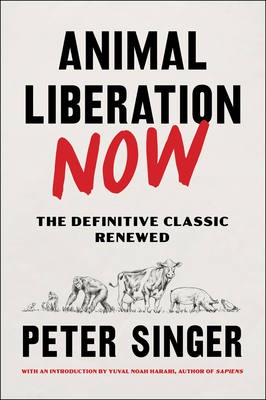
Title: Animal Liberation Now: The Definitive Classic Renewed
Author: Peter Singer
Published: 2023
Series: (standalone)
Genre: nonfiction, philosophy, veganism, animal rights, social movements
My Rating: 5/5 stars
The Blurb
Synopsis (from Goodreads) (truncated):
In Animal Liberation, Singer exposes the chilling realities of today’s factory farms and product-testing procedures, destroying the spurious justifications behind them and exposing just how woefully we have been misled.
Now, in this updated edition–revised from top to bottom–Singer brings us to the current moment, covering important reforms in the European Union and individual U.S. states. But he shows us how these measures are offset by the explosion of factory farming caused by unprecedented demand for animal products in China. Singer also explores how meat consumption is negatively impacting the earth, and reveals how factory farms pose a profound risk for spreading new viruses worse than Covid-19. In addition, Singer offers alternatives we can use to address this profound environmental, social, and moral issue.
My Thoughts
“We think of lions and wolves as savage because they kill; but they must kill, or starve. Humans kill other animals for sport, to satisfy their curiosity, to beautify their bodies, and to please their palates.”
Animal Liberation does a brilliant job of deconstructing what could be termed “carnist” or “speciesist” worldviews: the worldviews shared by a depressing number of people, and the views I held myself until I began deconstructing them in this same way. Unfortunately, I was 17 when I became vegan, and I have only been free of eating murdered animals for less than two years of my life at the time I am writing this.
Nonetheless, I have only become more and more convinced over these past 15 months that the treatment of farmed animals is one of the most staggering injustices of our current age, and regret almost nothing more than my participation in it throughout my childhood, the result of speciesist indoctrination from birth.
Singer’s book starts out with a definition of the term “speciesism” as a prejudice in favor of one’s own species based on species membership alone. Then, he launches into an exposé of the many manifestations of speciesism in our society, starting with the torture of animals in pointless lab experiments, and continuing on through animal product industries: meat, dairy, eggs, seafood, and clothing materials such as leather. Anyone with knowledge of modern intensive farming will be aware of most of the shocking industry practices he details, but still, I learned some things I was previously unaware of.
One thing I didn’t know is that broiler chickens, because of selective breeding that augments their growth so massively, would be unable to reproduce naturally if allowed to continue growing to their full sizes. Chickens who are killed for their meat at a young age don’t face this problem, but chickens who are kept for breeding would not be able to be “useful” if they grew to their full size– so they are starved instead, being fed only other day in order to keep them smaller and able to breed. Real evil shit.
The second half of Animal Liberation Now provides a philosophical justification for considering animals in the sphere of ethics. Singer briefly discusses effective altruism and dispels myths about the impracticability or lack of health benefits of veganism. (For the last time: veganism is NOT unhealthy or dangerous, and in fact confers many health benefits. It also is not difficult to eat on a vegan diet– there are SO many foods you can explore that are 100% vegan.)
Then, he discusses the history of speciesist ideas specifically in the West by providing an overview of historical perspectives on ethics. I greatly appreciated that he cites Christianity as one of the primary speciesist influences that have shaped our current attitudes towards animals, because that happens to be one of the reasons I have such a personal dislike for the Christian religion. (Thank you Peter Singer for calling out Augustine and Aquinas in this area!)
The conclusion of the book takes a look at current-day speciesism, a great rebuttal to common arguments against vegans (which are so often poorly disguised deflection) and Singer finishes with a call-to-action for the reader to cut speciesist practices out of their own life.
My main criticism of Singer is that he gives too much credence to things like “conscientious omnivorism“, which I think is counterproductive because it gives people an excuse to continue eating meat and perpetuates the status quo by insinuating that full veganism is “too hard.”
I also disagree with Singer’s statement that something like refusing to eat a cake offered to you at a party because it has eggs would be a useless action; I think that to eat a non-vegan cake at a party would be a betrayal to the movement because it would indicate to others that animal lives are less important to you than social convenience and acceptance.
Overall, though, I would highly, highly recommend this to everyone, even if you are already vegan, because it will serve to inspire you to continue fighting for the animals and even give you hope for the future.
I have found myself experiencing symptoms of “vystopia”, falling into spells of depression and anger at the world because of the seeming callousness of almost everyone towards the plight of non-human animals. However, this book gave me hope, especially with the number of notable intellectuals who wrote reviews and forwards to it. When you think about how fringe the animal rights movement used to be and then compare that to now, where a sizable number of celebrities are vegan and ideas like Singer’s are being discussed honestly in the public sphere, it paints a much more hopeful picture of the future.
This edition is an update to previous editions; the first edition of Animal Liberation was published in 1975 and even since then much progress has been made. It’s still not enough though, and we need as many people as possible to wake up to the oppression of animals.
 Frappes and Fiction
Great review, I agree on all your points. I would also add that Singer’s individualist approach might need to be reviewed as it opens up to incoherent and specieist behaviour, as you say in your comment.
LikeLiked by 1 person