 By
By The Brothers Karamazov is many things; a romantic drama, a portrait of an important cultural period, and even a murder mystery. But to me, it is first and foremost an exploration of the problem of evil and the paradox of meaning and hope in a world full of suffering.
About the Book
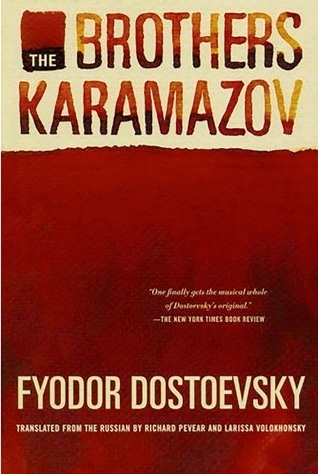
Title: The Brothers Karamazov
Author: Fyodor Dosteovsky
Published: 1880
Genre: classics, Russian literature, classic literature, Russian novel
My Rating: 5/5 stars
Synopsis (from Goodreads)
The Brothers Karamazov is a murder mystery, a courtroom drama, and an exploration of erotic rivalry in a series of triangular love affairs involving the “wicked and sentimental” Fyodor Pavlovich Karamazov and his three sons―the impulsive and sensual Dmitri; the coldly rational Ivan; and the healthy, red-cheeked young novice Alyosha. Through the gripping events of their story, Dostoevsky portrays the whole of Russian life, is social and spiritual striving, in what was both the golden age and a tragic turning point in Russian culture.
My Thoughts
My third Dostoevsky book– and a rather hefty undertaking. I will be honest: it took me nearly the entire fall semester to finish this. However, I was so glad I put in the effort to finish it.
For a book as influential and epic as The Brothers Karamazov, it’s hard to determine where to begin a review. In my years of writing book reviews, I’ve slowly moved away from criticizing books and have begun more to focus my debriefings on what aspects of the book really made an impact on me.
The Brothers Karamazov as a Character Study
Out of all of the authors I’ve read, Dostoevsky is uniquely character-focused. I find myself thinking about his books as an interconnected web of interactions between characters of intricate and often pathological psychologies. The characters always take center stage, and The Brothers K is no exception.
The titular brothers are each distinctly colorful. There’s Dmitri, whose impulsivity and sensuality (read: horniness for Grushenka) drives the plot forward, Ivan, (my personal favorite) who acts as a sounding board against the religious messages of the novel, and Alyosha, Ivan’s foil and arguably the novel’s main hero.
The father, Fyodor Pavlovich Karamazov, doesn’t get a ton of page time in comparison, but his influence is still felt throughout the book. Obviously, it’s his murder that is the main plot point– and it’s the desire to escape his shadow of hedonism and bad reputation that drives many of the actions of his sons.
I really loved the contrasts between these characters and how Dostoevsky allowed them to play off each other to reveal the themes of the novel. I most enjoyed the interactions between Alyosha and Ivan, which brings me to the next facet of The Brothers Karamazov that I’d like to talk about.
The Philosophy of Ivan Karamazov: “Rebellion”, “The Grand Inquisitor” and the Problem of Evil
“It’s not God that I don’t accept, Alyosha, only I most respectfully return him the ticket.”
Perhaps the most famous chapters of The Brothers Karamazov are “Rebellion” and “The Grand Inquisitor”, which explore the discussion between Alyosha and Ivan about the existence of God.
Ivan’s primary objections to the Christian theology held by Alyosha is the existence of suffering in the world. If this suffering on Earth is necessary to achieve heaven, Ivan argues, then he wants nothing to do with God.
“And if the suffering of children goes to make up the sum of suffering needed to buy truth, then I assert beforehand that the whole of truth is not worth such a price.”
“The Grand Inquisitor” goes on to explore the nature of religious authority and freedom. Is it possible to have order with true freedom? Is religion necessary for a functional society? Will people gravitate towards anything that gives them direction and purpose?
Without religion or divine order, Ivan concludes that “anything is permitted.”
“Anything is Permitted”
When I reflected on Ivan’s revelations throughout The Brothers Karamazov, the Kierkegaard quote, “anxiety is the dizziness of freedom” kept popping into my head. There are a lot of existentialist overtones in the novel, particularly with this idea Ivan grapples with– that without the authority of the Church, “anything is permitted.”
To show my cards here for a second: I am not religious. I deconverted from Catholicism almost two years ago, and am in fact quite anti-theist. However, though I would not say that atheism and nihilism are a necessary coupling, I did highly relate to Ivan’s anxiety over this idea.
When you leave religion, it feels like the world collapses around you. In the society in which The Brothers Karamazov was written, Christianity was integral to the worldview of most people. To step away from that would be a major paradigm shift in viewing the world. And there is a real fear that many people have that without religion comes meaninglessness and with meaninglessness comes total moral anarchy.
Honestly, I have not yet sorted this out in my head, either. I have strong moral convictions, but leaving religion has left me sometimes struggling to find justifications for them. It’s easy to fall into the trap of nihilism.
Ivan Karamazov’s breakdown at the end of the novel is a clear demonstration of the dangers of losing a basis for morality. He professes eagerly throughout the entire story that without God, “anything is permitted”– but when Smerdyakov actually puts this philosophy to the test and tells Ivan that he killed Fyodor and that this would be perfectly fine if “anything is permitted”, Ivan cannot handle it.
My personal interpretation of this is that few people are truly without principles. I believe that almost no one is a true relativist. I know several people who claim to be moral relativists, but I would be extremely surprised if none of them have a line beyond which their relativism and “anything goes” attitude breaks down. For Ivan, this line was parricide.
All You Need Is Love… I Mean Hope
So, what’s the overall message of The Brothers Karamazov? What did I take away from the book?
Honestly, if I could slap one single overarching theme on this book to summarize how I interpreted it, it’s that hope is what gets you through life on this Earth. The final chapter, when Alyosha speaks to the schoolboys about always being good, always having hope, regardless of what horrible things come to pass, regardless of the suffering in the world, or the existential questions that come part and parcel with being human, puts this into words probably better than I could. Without hope that good exists in the world, you could, like Ivan, drown in the anxiety and dread of it all.
Have you read The Brothers Karamazov by Fyodor Dostoevsky? If so, what did you think of it? Feel free to leave your thoughts in the comments!
This review was rather disorganized and stream-of-consciousness, and for that I apologize. It’s been a while since I last wrote a book review, and my brain is fried from finals.
If you liked this post, consider subscribing to Frappes & Fiction. I post about the books I read (even if they’re not fiction), the books I think YOU should read, and anything else on my mind.
 Frappes and Fiction